


See how Ema, the Enterprise AI Employee Platform for HR, IT and Finance, earned Warden Assured status through independent AI bias audits of its Recruiter.
Recruitment has become one of the most scrutinized places AI can work. In Warden AI’s State of AI Bias in Talent Acquisition research, 75% of corporate HR leaders named bias as a top concern when adopting AI.
For the Enterprise AI employee platform, Ema, trust starts with how its AI evaluates every candidate it screens. When an enterprise buyer or jobseeker asks whether or not the AI recruiter is fair, Ema can point to independent proof, becoming Warden Assured, which goes beyond what current regulation requires.
The person Ema screens today is the same colleague our platform will onboard tomorrow and champion across years of career growth. We refuse to let that relationship begin on unearned trust.
Deepika Mallyk, Product Leader, Ema Recruiter
Ema is a leading enterprise partner for building and deploying AI employees across all roles and industries.
Their mission is to transform business with the Enterprise AI Employees: agents that take on real work in HR, IT, and Finance inside the systems teams already use, with the governance large organizations require. In HR, that work follows a person from the first application to the last day.
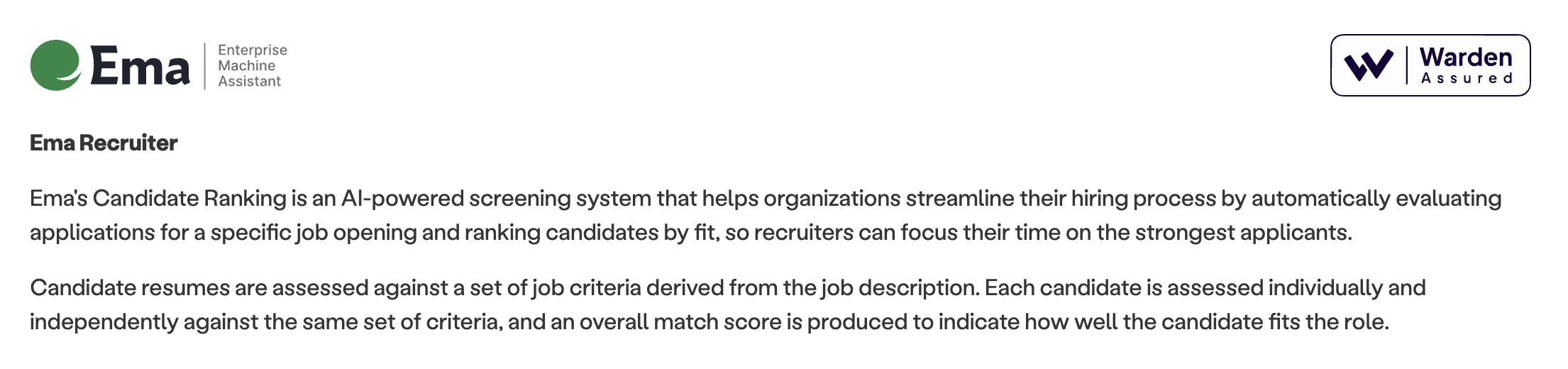
Ema Recruiter handles the start of that journey. The platform sources across more than 1 billion profiles and 30+ sources, scores each candidate against the job with the rationale attached, and runs personalized outreach.
Every AI Employee shares one context graph, so what Ema learns during hiring carries into every stage after it. Trust is a key component in Ema’s hiring process because whatever the AI employees learn from the start has the ability to transpire across all HR business operations.
Employment discrimination law has applied to hiring tools for decades, but testing AI systems for bias is relatively new. A growing patchwork of AI regulations in the US and globally, along with lawsuits like Mobley v. Workday has now made bias risk a question of vendor liability.
As a result, corporate procurement teams are more skeptical. Before an AI product is purchased, they are asking for evidence that the vendor’s product is fair and trustworthy.
Traditional compliance certifications offer limited assurance when it comes to AI-specific risks. ISO 27001 and SOC 2 primarily address information security and related controls, rather than the fairness of AI systems. While ISO/IEC 42001 introduces requirements for responsible AI management, including addressing bias, it does not prescribe a universal methodology for conducting bias testing.
For Ema Recruiter, that gap of what good looks like in AI bias testing matters. Its AI makes a series of judgments about people, everything from which candidate moves to the next stage to which company policy applies to whom.
Discerning enterprise buyers want to know two things. Does Ema Recruiter score its candidates fairly? And is this AI they can trust?
Currently one law sets explicit guardrails for third-party bias testing in HR and recruitment: New York City Local Law 144. Since enforcement began on July 5, 2023, the law states any employer using an automated tool to screen or evaluate candidates for roles connected to the city must conduct an annual independent bias audit.
Independent is the operative word. A vendor that grades their own homework does not meet the standard NYC LL 144 sets, and therefore offers enterprise buyers little more than a promise.
An annual audit, the most NYC LL 144 requires, only shows how an AI system performs at one point in time. AI models drift, they get updated, candidate pools shift, and more state and international regulations are raising the bar. Ongoing audits are necessary to detect changes in system behavior and maintain assurance over time.
Enterprise buyers expect independent proof that a vendor keeps their data secure. Fairness deserves the same standard. Most vendors will tell you their AI is fair. Very few can show you, month after month, with independent evidence.
Martyn Redstone, Head of Responsible AI and Industry Engagement at Warden AI
Because Ema treats fairness as a foundational product requirement, starting with Recruiter and carrying through every stage after the hire, they sought to earn Warden Assured status to satisfy enterprise due diligence and meet the compliance gap.
As a standard, Warden Assured operationalizes the regulations that recommend bias testing but stop short of technical guidance. Because AI in hiring carries high ethical and regulatory stakes, Ema undergoes independent, ongoing AI bias testing.
For Ema Recruiter, the auditing process covers:
Each Ema Recruiter audit tests for seven types of bias: sex, race/ethnicity, intersectional, age, disability, religion, and sexual orientation.
Disparate impact analysis compares outcomes across groups to check whether Recruiter scores one protected group lower than another.
Counterfactual testing keeps a candidate profile the same and changes a single protected attribute, such as a name that signals gender, to check whether that change alone moves the score.
Warden evaluates Ema Recruiter against external datasets and baselines rather than data supplied by Ema, which keeps the results independent.
Warden audits Ema Recruiter every month, so the results reflect the system as it runs currently.
Ema’s audit results are mapped to AI regulations such as NYC LL 144 and the EU AI Act and then audit results and compliance reports are shared with buyers.
Ema Recruiter earned Warden Assured status in October 2026 and keeps it by continuing to meet all five assurance measures: third-party oversight, ongoing audits, independent benchmarks, dual-method bias detection, and compliance mapping.

Ema’s Warden Assured status goes beyond compliance. It has led to:
Perhaps most importantly for Ema, there is trust built into the hiring pipeline. Because of the unique nature of Ema Recruiter and Ema’s larger AI employee base, if a bias begins on day one then it has the ability to spill over in other areas of the organization. And that is a risk the organization is not willing to take.
Ema will continue expanding Recruiter's capabilities, with Warden auditing the product on a monthly cadence and after every major product release. As new capabilities deploy, each hire Recruiter supports transitions into Ema’s broader HR Hub, operating on one governed system from first screen to last day.
Learn more about Ema.
Read Ema’s article on AI trust and responsibility.
See Ema on the Warden Assured Directory.


