
.png)
.svg)
Discover how Mega HR chose to stress-test their AI system at an important stage of product development.
Mega HR builds agentic AI systems designed to improve hiring and interview quality, and strengthen talent strategy, integrating directly into leading applicant tracking systems like Greenhouse, Ashby, and Lever.
Its screening technology evaluates candidate profiles against structured, job‑relevant criteria. Each applicant is assessed consistently, against the same requirements, with outputs designed to be transparent and measurable.
Mega HR partnered with Warden to perform independent, ongoing bias testing under the Warden Assured methodology at a stage where most organizations are still refining features internally.
Instead of solely relying on internal testing, Mega HR engaged Warden as a specialist AI bias auditor to help mitigate issues early in the development cycle.
Mega HR sought pre-market bias testing for three key reasons:
Rather than waiting for customer audits or regulatory scrutiny, Mega HR proactively sought Warden to test its system in a controlled, pre-release environment.
Mega HR’s AI screening product was evaluated using Warden’s purpose-built dataset. Multiple bias-detection techniques were applied to evaluate the system’s behavior on this dataset at the time of testing.
The pre-launch testing evaluated whether the system’s outputs showed evidence for potential bias across protected characteristics, including sex and race/ethnicity.
The evaluation included:
Given this was performed before release, no live or historical data was available to test. Testing was performed using Warden’s purpose-built datasets for AI hiring use-cases.
During a routine pre-release audit of Mega’s agentic evaluation system, Warden identified a subtle bias pattern. Mega’s team quickly implemented improvements, refining the model and validating the mitigation steps in follow-up testing.
The pattern surfaced under counterfactual testing, a method where candidate profiles are held constant except for a single protected characteristic, such as gender or race, to isolate whether that attribute alone influences the system's output.
The results indicated that specific changes to the input data shared with the AI model would improve performance against fairness metrics.
As with many pre-release tests, these findings were not unexpected and provided important insight into areas for improvement before release.
The findings were handled through Warden’s continuous assurance approach: audit, results, remediate any issues, and repeat.
Bias evaluation is rarely linear. Systems evolve, inputs change, prompts are refined, and model behavior can shift over time.
The Warden approach operates as an ongoing loop of testing, fixing, and monitoring until the system meets the standard.
Mega HR collaborated with Warden’s technical team to investigate the root cause.
To strengthen its safeguards, Mega HR:
This case reflects how Mega HR approaches product development.
Fairness and consistency are integrated into:
Ongoing independent evaluation strengthens reliability, industry‑leading transparency, and trust before customers ever experience the product.
Independent evaluation is conducted as an expert collaboration to raise the bar on system performance, supporting DEI‑aligned model evaluation across data selection, prompt flows, agentic decision chains, and model evaluation pipelines.
While many SaaS companies rely on post‑deployment validation, customer‑led audits, or regulatory triggers before engaging independent review, Mega HR brings independent auditors in before deployment as a matter of principle, which sets a higher bar for responsible AI in hiring.
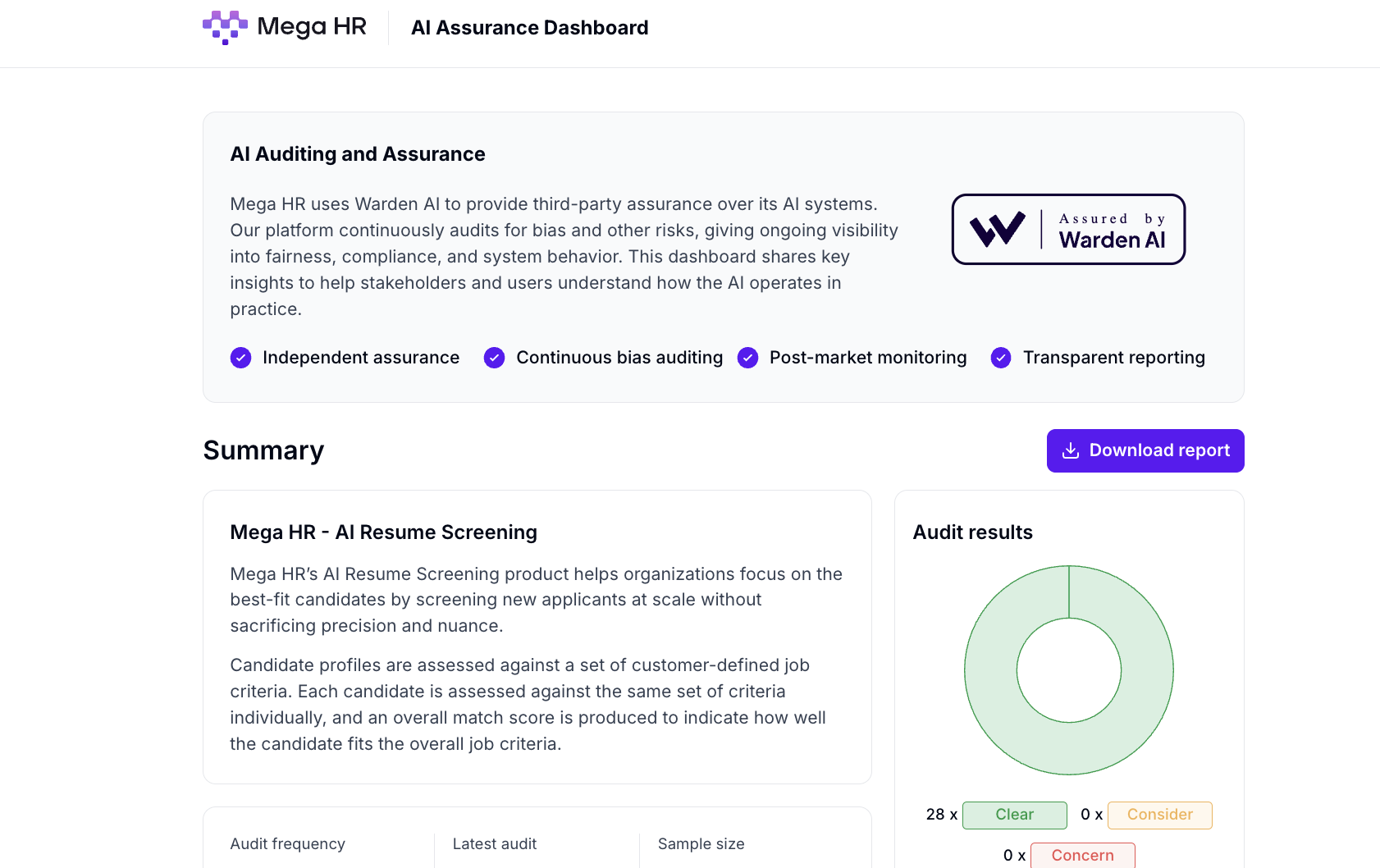
Check out the Mega HR AI Assurance Dashboard here.
Learn more about Mega HR’s DEI-aligned model evaluation.


